An interview with Marcin Michalak – Network Management Director at DPD Polska
With Marcin Michalak, Network Management Director at DPD Polska, we discuss the impact of the COVID-19 pandemic on the operations of courier companies, the challenges involved in managing one of the largest transport networks in Poland, as well as the implementation process and the business benefits of using the TMS-class system supplied by Omecon.
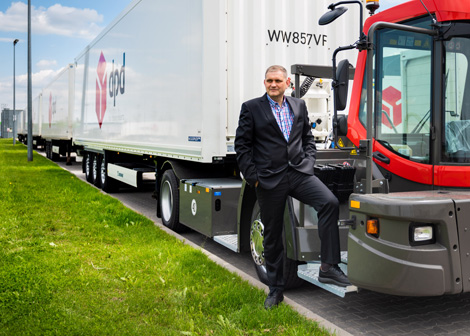
This article is an interview that appeared in the June issue of ITwiz magazine.
Given the scale of our operations, it would be more difficult without a new TMS system
How much has the situation in the courier services sector changed with the onset of the COVID-19 pandemic?
During the pandemic, the role of couriers increased significantly, as they became the main intermediaries in day-to-day trade. Significant growth was driven, amongst other things, by increased activity in the e-commerce sector. Throughout 2020, we delivered 193.5 million parcels. This figure is over 24 per cent higher than the previous year, and in the first half of the year – mainly due to the restrictions introduced in March 2020 – growth reached as much as 30 per cent. At peak times, 7,500 couriers were working for us every day. In many cases, courier services became the only viable distribution channel, which had a significant impact on the scale of operations for companies in the CEP sector.
The nature of our business has also changed. Previously, we observed the main peaks in network demand primarily at the turn of November and December. As a result of the pandemic, our steady workload throughout the second quarter of 2020 remained at a level typical for December. This is a very significant change, because if we handle 700,000 parcels every day, a 30 per cent increase suggests that our network is handling 200,000 more parcels on any given day. Translating this into lorry transport, it means that, from one day to the next, we needed an additional 200 lorries. Seasonality, which is a natural and constant feature of the courier business, required us to be able to scale our processes. These skills – and technical capabilities – proved invaluable during the first few weeks of the COVID-19 restrictions.
How much did DPD’s way of operating change at that time?
We were able to scale up our operations at short notice thanks to systematic investment in infrastructure development and the operational efficiency of individual branches. With spare capacity at our disposal, we were able to ramp up our infrastructure very quickly to ensure the required operational efficiency. Furthermore, we reorganised our business processes to operate on a 24-hour basis.
Meanwhile, in the area of the so-called ‘last mile’, we implemented a number of services and solutions that enabled us to deliver parcels to recipients in a safe yet formalised manner. I am referring here, amongst other things, to solutions facilitating contactless delivery and dispatch of parcels. We have also equipped couriers with new, more user-friendly terminals supporting cashless payments.
Changes have also taken place in the area of lorry transport. We have introduced electronic waybills and contactless lorry check-ins. Most of the team worked remotely, which required modifications to our IT systems. This would have been impossible without a robust and efficient TMS (Transport Management System), which enabled us to scale up our operations quickly and easily.
“Thanks to the implementation of the new TMS system following the outbreak of the COVID-19 pandemic, we were able to introduce the electronic consignment note functionality within a short space of time. Digital documents are sent directly from the TMS solution to the drivers’ app, meaning that the entire transport clearance process takes place contactlessly. I believe we were the first on the market to implement this functionality. This was made possible precisely by the extensive capabilities of the platform provided by Omecon. During the pandemic, we operated at full system capacity 24 hours a day, 7 days a week, in continuous mode, without any major difficulties or downtime. During this time, we also rolled out new features and solutions related to the pandemic quickly and effectively. It is precisely this speed and effectiveness that are of strategic importance here.”
How significant is the area of scheduled transport for your business?
The transport department is the lifeblood of a logistics company. The timeliness and accuracy of the flow of goods between branches depend on its efficiency, which is crucial to the quality of the freight forwarding services we provide. In turn, the heart of the transport department is the TMS system, which enables us to ensure the timely collection and delivery of goods at individual branches in a planned and coordinated manner. The solution is also responsible for handling and effectively managing transport operations involving the loading and unloading of lorries. Our network comprises almost 1,500 lorries and 2,500 semi-trailers operating on a 24-hour basis, which illustrates the scale of the company’s transport operations. Each month, our hauliers cover approximately 12 million km, making us one of the largest transport networks in Poland. At DPD Polska’s central sorting centre in Stryków, an average of 50 truck-and-trailer combinations are processed per hour. Any disruption to parcel handling operations, as well as to the loading and unloading of lorries, has consequences. A quarter of an hour’s delay results in several thousand unsorted parcels and may even lead to disruption to local traffic.
When and why did you begin the process of changing your TMS system?
We carried out our initial analyses to select a new TMS solution in 2017. We had been using a solution developed specifically for DPD Polska over a dozen years earlier, which did not guarantee sufficient scalability or flexibility. That system’s functionality was no longer meeting our needs, and its performance did not meet the market and technical standards of the time. Even before the COVID-19 pandemic, we had been seeing a steady increase in the scale of our operations. We therefore knew that, at some point, we would face the problem of the system’s insufficient performance. We also lacked the ability to easily integrate the TMS with specialist solutions supporting our processes, including automation systems.
The decision to change our TMS was also driven by company policy. We always strive to take proactive measures to anticipate actual needs, so as to ensure the best possible customer service. We are focused on eliminating challenges before they actually arise. This approach paid off in March 2020. Initially, we focused on finding a ready-made solution that would guarantee sufficiently high performance and availability. Its flexibility was also important. Ultimately, it turned out that, given the large scale of our operations and the specific nature of our transport network, none of the available solutions met our expectations. It became necessary to implement a system tailored to our needs.
A key factor in choosing a bespoke solution was the fact that, within our organisation, several hundred staff working across 60 branches and 3 sorting centres use a TMS-class system on a rotational basis. We were keen for the new solution to be modernised from the user’s perspective, whilst remaining similar to the one used previously. In this way, we wanted to avoid a major upheaval in terms of system operation.
Ultimately, you chose a solution built on Omecon’s &UP® platform…
The system supplied to us by Omecon is a new solution whose specifications have been tailored to our needs and enhanced with the features we require. Many factors influenced our choice of the proposal. Firstly, the solution offered to us ensured the expected increase in efficiency, as well as security and business continuity. We also appreciated the Omecon team’s commitment to resolving any issues or concerns we raised.
Equally important was the solution’s architecture and its modular design, which allows us to expand the system’s functionality relatively easily and implement changes to meet our business’s evolving needs. Thanks to its modular design, we can respond quickly to market demands, whilst the extensive possibilities for integration with other transport-related solutions guarantee further opportunities to optimise our processes.
“The TMS-class system built by the Omecon team is now the cornerstone of DPD Polska’s scheduled transport operations. It is fed with operational data from systems supporting retail transport operations. It is responsible for distributing timetables, generating confirmations of completed operations, as well as transport orders and waybills, and for the day-to-day management of parcel transport processes between our sorting centres and branches. It also supports carrier settlement and invoicing. It is hard to imagine our company operating without this solution today.”
How do you recall the process of implementing the new TMS system? Was the scale of your organisation a major obstacle?
The scale was only part of the challenge. The specific nature of our processes means that there are virtually no maintenance windows in our operations. As I mentioned, any interruptions to transport operations – and therefore to the availability of the TMS solution – present further challenges in this context. It was essential to maintain full operational capacity, which is why we divided the system’s implementation into two phases. The first involved running two solutions in parallel. We duplicated all operations in the existing system and in the tool provided by Omecon. At that stage, the older solution remained the basis of our operations, whilst the newer one served a supporting role. Once the new system had stabilised and we’d received positive feedback from users, we reversed this arrangement. The new solution became the primary one, whilst the older one served as a backup. Once all operations had been verified, we decommissioned the old system. I believe that the entire process – despite its complexity – went smoothly and without any major surprises, which I attribute largely to the Omecon team supporting us and the specialists from DPD Polska. The solution went live in August 2020. All our expectations regarding functionality, performance and the supplier’s response times were met in line with the agreed KPIs and SLAs. Any issues – which are to be expected with this type of project – were resolved quickly and efficiently.
Our operational efficiency has also been enhanced by the user-friendliness of the new solution, as well as its additional functionalities and integration capabilities. Having experience of working with the &UP® system, we realise that, in the face of the changes brought about by the COVID-19 pandemic and given the scale of our operations, our operational capabilities would have been limited had we stuck with the old TMS system.
“In terms of process efficiency, the ability to quickly integrate the Omecon TMS solution with other specialist systems proved very useful. Following its implementation, we were also able to utilise the functionality of the so-called ‘electronic seal’ within a short time, which has been fully integrated into the system. Thanks to this, we have up-to-date information on the actual location of each of our trailers at any given moment. We can monitor the routes they take and any unauthorised access to the cargo area.”
How has the implementation of the TMS solution provided by Omecon impacted the efficiency of business processes within your company?
The TMS-class system built by the Omecon team has become the cornerstone of DPD Polska’s scheduled transport operations. It is fed with operational data from systems supporting retail transport operations. It is responsible for planning and distributing timetables, generating confirmations of completed operations, as well as transport orders and consignment notes, and for the day-to-day management of parcel transport processes between our sorting centres and branches. It also supports carrier settlement and invoicing.
In terms of process efficiency, the ability to quickly integrate the Omecon TMS solution with other specialist systems has proved very useful. Following its implementation, we were also able to utilise the functionality of the so-called ‘electronic seal’ within a short time, which has been fully integrated with the system. Thanks to this, we have up-to-date information on the actual location of each of our trailers at any given moment. We can monitor the routes they take and any unauthorised access to the cargo area.
The implementation of the new TMS system right at the start of the pandemic enabled us to quickly introduce the functionality of another supplier’s electronic consignment note. Digital documents are sent directly from the TMS solution to the drivers’ app. As a result, the entire transport clearance process is contactless. I believe we were the first on the market to implement this functionality.
What are your main plans regarding the modernisation of systems supporting the operation of the transport network?
In the area of transport network management, we are working, amongst other things, on making greater use of automation for the most repetitive operations. We are focusing on unmanned dispatch processes, streamlining driver support, and the digitisation of documents. We are aiming for a situation where a driver on a regular DPD Polska transport route will drive independently into the transhipment yard, check in via an app that will guide them to a specific bay, but will also indicate when to unhitch one semi-trailer and pick up the next. All information will be automatically retrieved from the system, and every stage of the process will be verified. As part of our collaboration with the Omecon team, we are also developing a TMS system. Among other things, we are currently creating interactive, self-service portals for our branches and carriers.
“During the pandemic, the role of couriers increased significantly, as they became the main intermediaries in day-to-day trade. Significant growth was driven, amongst other things, by increased activity in the e-commerce sector. Throughout 2020, we transported 193.5 million parcels. This figure is over 24 per cent higher than the previous year, and in the first half of the year – mainly due to the restrictions introduced in March 2020 – growth reached as much as 30 per cent. At peak times, 7,500 couriers were working for us every day. In many cases, courier services became the only viable distribution channel.”
The interview was conducted by Piotr Waszczuk.